One of the things I quickly discovered (and love!) about pisco is its ease of being mixed in a variety of cocktails. Sure, there's the go-to Pisco Sour or the Pisco Punch (well, the authenic recipe isn't as go-to as it sounds, but that's a story for another day...); but as I've learned, there are so many more flavors that compliment a well-made pisco. I have a few examples of intriguing cocktails that may have come out of the formula for a traditional Pisco Sour and thought I'd share online.
The first cocktail I enjoyed was over my Thanksgiving vacation in Phoenix, Arizona. During my stay, I meandered my way over to the new (to me, at least) Scottsdale restaurant and bar, Culinary Dropout, where I knew my order before even looking at the menu. You see, (Houston) Anvil Bar's Mindy Kucan had recommended to me via Twitter that the Pisco Painkiller on Culinary Dropout's menu was, and I quote, "deeeeeeelicious." And her recommendation did not disappoint. The drink was built with Don Cesar Pisco, Pineapple Juice, and Cream of Coconut, and was dotted with orange bitters on the slightly frothy top. A very light drink with a similar build to a Pisco Sour in terms of the ingredients called for, this drink was gone before I even remembered to take a picture. Whoops.
Another pisco cocktail I've been meaning to give my praise to was Jacob Grier's entry for the Great American Distillers Festival cocktail competition, called Pisco con Platanos. With the wonderful idea to develop a spiced plantain foam, I will concur with him when he says, it is "an entirely different direction with this twist on a Pisco Sour ". With a high-quality pisco, and perhaps a bit of patience on my part, I hope I can try and replicate this cocktail at home for a special occasion. But I really should leave these molecular, foam-making things to the experts like Jacob... :)
Salud!
SJ
Showing posts with label Pisco Sour. Show all posts
Showing posts with label Pisco Sour. Show all posts
12.15.2010

11.26.2010
Well, it seemed like a good idea at the time
So what did we find out? We did in fact prove that copper makes better egg white foam in a Pisco Sour...when you make it without the lime. We also find out that contrary to what we had read, Lime doesn't help , in fact just the opposite.
Here's the process we used...the recipe was of 2 ounces of Pisco Porton (from my private stash handcrafted by the inimitable Johnny Schuler), 1 ounce of fresh-squeezed lime juice, 1 ounce of simple syrup (1:1 concentration) and three drops of bitters on the foam.
Method 1 was a steel one-piece shaker loaded with a handful of copper plumbing fixtures.
Method 2 was the same recipe using a traditional Boston Shaker.
(For one set of the tests we also tried whisking the mixture in a copper bowl which just made a big mess.)
Results...disappointingly, they were very comparable in terms of amount of foam and stability (I can't tell you how long it lasted because we drank the samples...hey, I'm just saying!)
Then we decided to isolate one of the variables. So we did it a couple of times with the same two methods but without the lime and found that we ended up with much better foaming properties for the copper fitting method...we could even create little peaks in the foam.
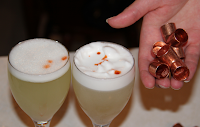
When lime was used we couldn't reproduce that. So while that absolutely trustworthy resource Wikipedia said that you can duplicate the effect of whipping egg whites in copper by using citric acid from a lemon, or using cream of tarter (potassium bitartrate), in our tests, we were not able to reproduce those results.
OK, so using copper fittings isn't necessarily a commercial solution, but Fred Yarmj of Cocktail Virgin Slut suggested we try copper scrubbing pads, which we'll do tomorrow...more surface area in contact with the egg, less fracturing of the ice which led to somewhat watered down drinks. then I'm going to go on the hunt for a copper lined shaker...anyone know of a source?
Here's the process we used...the recipe was of 2 ounces of Pisco Porton (from my private stash handcrafted by the inimitable Johnny Schuler), 1 ounce of fresh-squeezed lime juice, 1 ounce of simple syrup (1:1 concentration) and three drops of bitters on the foam.
Method 1 was a steel one-piece shaker loaded with a handful of copper plumbing fixtures.
Method 2 was the same recipe using a traditional Boston Shaker.
(For one set of the tests we also tried whisking the mixture in a copper bowl which just made a big mess.)
Results...disappointingly, they were very comparable in terms of amount of foam and stability (I can't tell you how long it lasted because we drank the samples...hey, I'm just saying!)
Then we decided to isolate one of the variables. So we did it a couple of times with the same two methods but without the lime and found that we ended up with much better foaming properties for the copper fitting method...we could even create little peaks in the foam.
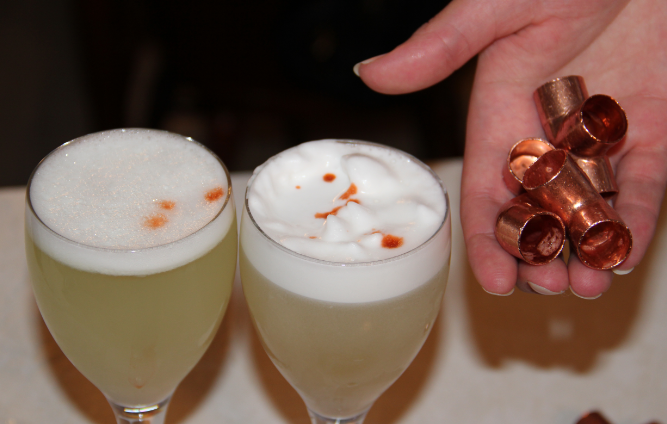
When lime was used we couldn't reproduce that. So while that absolutely trustworthy resource Wikipedia said that you can duplicate the effect of whipping egg whites in copper by using citric acid from a lemon, or using cream of tarter (potassium bitartrate), in our tests, we were not able to reproduce those results.
OK, so using copper fittings isn't necessarily a commercial solution, but Fred Yarmj of Cocktail Virgin Slut suggested we try copper scrubbing pads, which we'll do tomorrow...more surface area in contact with the egg, less fracturing of the ice which led to somewhat watered down drinks. then I'm going to go on the hunt for a copper lined shaker...anyone know of a source?
Optimizing Egg White Foam in a Pisco Sour
The idea occurred to my daughter Lindsay and me when she was making a birthday cake for my wife. Why do cooks whip egg whites in copper pots? My first stop was a query to Darcy O'Neil, of Art of Drink fame, drink chemistry guru and author of the definitive book on soda fountains titled Fix the Pumps. His answers combined with a little digging in the literature surfaced the chemistry behind it. There are basically two factors at work here, one physical, and one chemical. The physical whisking folds air into the albumen creating the foam. But it also unravels some of the amino acid molecules "opening them up" to combine with the air and water. When you whip in copper, the physical contact with the whisk frees up some copper ions that combine with the sulphur in eggs to make those unraveled amino acid bonds with water and air much more stable...yielding a more stable foam.
So the next question was, how come we don't use copper lined shakers in bars that make drinks with egg whites as an ingredient like the Pisco Sour, Ramos Gin Fizz et al.?

Darcy didn't have an answer to that one, nor a source for copper-lined shakers, though he did suggest testing the theory with copper ball bearings, the thought being ice may not be hard enough in a shaker to release the copper ions. (and a suggestion to use a solid metal shaker rather than a Boston Shaker!)
Two other alternative methods that improve foam stability are to add an acid (citric acid from the limes in the recipe may already be maximizing the foam),and cream of tartar which also lowers the pH.
So we're going to do some experimenting and determine whether or not we can use this copper/egg white interaction to make a better Pisco Sour. Not having access to copper ball bearings, I'm thinking I'll stop by the hardware store for some copper plumbing fittings and a micrometer and stop watch to measure foam height and stablility.
Stay tuned...more to come.
So the next question was, how come we don't use copper lined shakers in bars that make drinks with egg whites as an ingredient like the Pisco Sour, Ramos Gin Fizz et al.?

Darcy didn't have an answer to that one, nor a source for copper-lined shakers, though he did suggest testing the theory with copper ball bearings, the thought being ice may not be hard enough in a shaker to release the copper ions. (and a suggestion to use a solid metal shaker rather than a Boston Shaker!)
Two other alternative methods that improve foam stability are to add an acid (citric acid from the limes in the recipe may already be maximizing the foam),and cream of tartar which also lowers the pH.
So we're going to do some experimenting and determine whether or not we can use this copper/egg white interaction to make a better Pisco Sour. Not having access to copper ball bearings, I'm thinking I'll stop by the hardware store for some copper plumbing fittings and a micrometer and stop watch to measure foam height and stablility.
Stay tuned...more to come.
Subscribe to:
Posts (Atom)
