Showing posts with label Johnny Schuler. Show all posts

3.12.2011

You Gotta buy this Book!


Kudos to author Greg Dicum and the folks at ClearGrape, Shelley Alger and Tim Childs for publishing a fabulous new book on Pisco titled "The Pisco Book". (It's available for sale at Amazon.com, but hurry, there are only 18 copies left!)

Folks, this is the new definitive source on the subject of Pisco. Whether you're in the cocktail community or just love a good story, you'll enjoy this read. If you’ve ever wondered what the difference is between a falca and an alembique, where the name Pisco really came from, or the Peruvian/Japanese origins of ceviche, you’ll find the answers here.

In our travels around the country to mixology bars and conversations with bartenders, cocktail writers and aficionados, we’re seeing the nascence of an emerging trend. People are looking for something new and different from vodka, tequila and rum. And Pisco clearly (no pun intended) fills the bill.

There are some great Pisco recipes in the book, several created and contributed by Pisco Maestro Johnny Schuler, Jim Meehan of PDT, Dus Dushan Zarick of Macao Trading Co. and a few that are on our “we gotta try these next” list.

2.06.2011

What's a "Discontinuous" Still

OK, here's one for the real spirits geeks out there. In researching some background material on Pisco requested by Camper English of Alcademics fame, we came across several references to "discontinuous" stills. I've been in the industry for more than 20 years and up till now had never heard that word.

My understanding is that there are basically two kinds of heat distillation (cold distillation like that used to make applejack is another method:

1.Continuous also known as column stills. Continuous means the system cycles product through the columns for a continuous stream of output.


2. Alembic or pot stills, which are used for batch distillation. In this method spirits are produced in batches, the heads and tails are discarded and the "heart" of the distillate is used for the final product. Output is of course in batches. (That's Johnny Shuler, Master Distiller at Pisco Porton by some classic cognac stills imported from France.)


There are pros and cons for each of these methods and I'm not going to go into that here...I bet everyone who reads this column knows them already.

But this "discontinuous" thing is bugging me. I reached out to friends Shelley Alger at Cleargrape who kindly forwarded me source material from INDECOPI, the Peruvian agency that looks after intellecutal property, and writer Greg Dicum who wrote "The Pisco Book" which should be coming out soon. My supposition is that it probably stems from a bad translation of some Spanish word in some regulation and then got included and reused in other references.

My problem with the word is that it presupposes the standard is a continuous still. In reality the original still design is the alembic which goes back to the Alchemists in the Middle Ages and the Arab discovery of distillation before that. It's sort of like us calling a car a "horseless carriage". That's an anachronism, but a discontinuous still is just plain wrong.

I would like to know if anyone has seen the use of "discontinuous" still in any other references? And does it bug anyone else?

11.26.2010

Well, it seemed like a good idea at the time

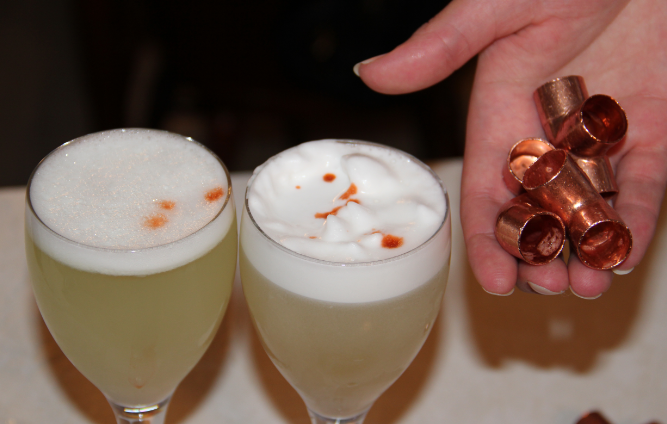
So what did we find out? We did in fact prove that copper makes better egg white foam in a Pisco Sour...when you make it without the lime. We also find out that contrary to what we had read, Lime doesn't help , in fact just the opposite.

Here's the process we used...the recipe was of 2 ounces of Pisco Porton (from my private stash handcrafted by the inimitable Johnny Schuler), 1 ounce of fresh-squeezed lime juice, 1 ounce of simple syrup (1:1 concentration) and three drops of bitters on the foam.

Method 1 was a steel one-piece shaker loaded with a handful of copper plumbing fixtures.

Method 2 was the same recipe using a traditional Boston Shaker.
(For one set of the tests we also tried whisking the mixture in a copper bowl which just made a big mess.)

Results...disappointingly, they were very comparable in terms of amount of foam and stability (I can't tell you how long it lasted because we drank the samples...hey, I'm just saying!)

Then we decided to isolate one of the variables. So we did it a couple of times with the same two methods but without the lime and found that we ended up with much better foaming properties for the copper fitting method...we could even create little peaks in the foam.


When lime was used we couldn't reproduce that. So while that absolutely trustworthy resource Wikipedia said that you can duplicate the effect of whipping egg whites in copper by using citric acid from a lemon, or using cream of tarter (potassium bitartrate), in our tests, we were not able to reproduce those results.

OK, so using copper fittings isn't necessarily a commercial solution, but Fred Yarmj of Cocktail Virgin Slut suggested we try copper scrubbing pads, which we'll do tomorrow...more surface area in contact with the egg, less fracturing of the ice which led to somewhat watered down drinks. then I'm going to go on the hunt for a copper lined shaker...anyone know of a source?