2.22.2011

Let's talk Turkish... wine!


By this time, you probably think I'm crazy, but actually Turkish wine making tradition dates back beyond many of the world's best known wine regions (estimated 7000BC.) It's also the fourth-largest wine producing region in the world so you'd better listen up.

Consider yourself lucky that you've stumbled upon this post - you're ahead of the curve. The bittersweet news is, you won't be for long. This Thursday, February 24th, the Wines of Turkey will be kicking off their international campaign in London, aiming to educate the world on Turkish wine. The event will include a grand tasting of the organization's 7 active wineries as well as testimony and education as well as to hear testimony from leading international wine experts, historians, DNA experts and viticulturalists.

This isn't their only stop though - the Wines of Turkey also plans to participate in some of the world's most prestigious trade events such as ProWein, the London International Wine Fair and Vinexpo.

In the US, Kavakliderie Wines Co. is the best-known Turkish producer which has been a highly-celebrated producer for many years, changing the minds (and palates) of skeptics over and over again.

At BAT, we have worked with the Turkish producer - Vinkara Wines - an up-and-coming winery determined to change the world's perception about Turkish wines... and we think they can do it!

Sure, the country's top grapes are those that can be quite difficult to pronounce such as Narince (likened to Chardonnay) and Kalecik Karasi (likened to Pinot Noir)- but with so many other hard-to-pronounce varieties coming into the limelight at the same time (re: Gruener Veltliner & Agiogritiko) this is only a minor challenge.

So if you're looking for something new, or even if you're not, keep an eye on Turkish wines, their success has only just begun.

-CC

2.18.2011

Action in the Nutmeg State

There seems to be a lot of action lately fermenting in our own backyards here in Connecticut!

First, there has been a craft beer movement forming among many of the state's breweries and brewpubs as local legislators introduce a new bill which, if/when passed, will establish official state support for the development of the CT Beer Trail. The purpose of the legislation is to promote "…the manufacturing and sale of Connecticut made beer" and would help to bring greater distribution to many of Connecticut's fantastic breweries. In addition, 90% of Americans now live within 50 miles of a craft brewery (according to figures released by Beer Marketer's Insights) and implementing a CT Beer Trail would help in supporting and leveraging local businesses. Just as it has already been done on the wine side with the collaboration of 20 Connecticut vineyards, I hope that the creation of a network such as the CT Beer Trail will help to connect local beer enthusiasts and attract out-of-state visitors alike.

While living in Connecticut, I have been able to sample the suds from three local breweries and was thrilled, with the implementation of this organization, to learn about even more teams brewing here in the state. So, secondly, I was thrilled this week to read an article in the Hartford Courant about a team in Manchester, Onyx Spirits, that is producing a limoncello, vodka, and - most intriguing to me - moonshine. While there is still much to unearth about this start-up distillery and when their products may first be available in local package stores, restaurants or bars, it is refreshing to see that there are other passionate liquor entrepreneurs in Connecticut.

I look forward to following the continued news about all of these local organizations!

Cheers! SJ

2.06.2011

What's a "Discontinuous" Still

OK, here's one for the real spirits geeks out there. In researching some background material on Pisco requested by Camper English of Alcademics fame, we came across several references to "discontinuous" stills. I've been in the industry for more than 20 years and up till now had never heard that word.

My understanding is that there are basically two kinds of heat distillation (cold distillation like that used to make applejack is another method:

1.Continuous also known as column stills. Continuous means the system cycles product through the columns for a continuous stream of output.


2. Alembic or pot stills, which are used for batch distillation. In this method spirits are produced in batches, the heads and tails are discarded and the "heart" of the distillate is used for the final product. Output is of course in batches. (That's Johnny Shuler, Master Distiller at Pisco Porton by some classic cognac stills imported from France.)


There are pros and cons for each of these methods and I'm not going to go into that here...I bet everyone who reads this column knows them already.

But this "discontinuous" thing is bugging me. I reached out to friends Shelley Alger at Cleargrape who kindly forwarded me source material from INDECOPI, the Peruvian agency that looks after intellecutal property, and writer Greg Dicum who wrote "The Pisco Book" which should be coming out soon. My supposition is that it probably stems from a bad translation of some Spanish word in some regulation and then got included and reused in other references.

My problem with the word is that it presupposes the standard is a continuous still. In reality the original still design is the alembic which goes back to the Alchemists in the Middle Ages and the Arab discovery of distillation before that. It's sort of like us calling a car a "horseless carriage". That's an anachronism, but a discontinuous still is just plain wrong.

I would like to know if anyone has seen the use of "discontinuous" still in any other references? And does it bug anyone else?

1.24.2011

Sweet Reminders of Summer

The temperature gauge in the car read zero degrees in my morning commute to work. Zero! And forecasts predict another storm is making its way to our segment of New England tomorrow and Wednesday, adding to the heaps and heaps of snow that are already piled along our streets.

So this past week's "Thinking of Summer" theme in the Thursday Drink Night chat room provided a welcome respite from the hellacious winter weather outside. To the backdrop of Jimmy Buffet tunes (because it wouldn't be summer without a rousing rendition of "Margaritaville"), the drink I submitted to the queue is one that definitely hit the mark on summer-inspired tastes. Albeit not quite as fresh, this drink still may be a work in progress. Good thing I have a few months to work out the tweaks.

Surprisingly Sweet
  • Basil leaves
  • 1/2 oz lemon juice
  • 1/2 oz simple syrup
  • 1/2 oz St. Germain Elderflower Liqueur
  • 2 oz Gin (I used Beefeater)
Muddle basil with lemon juice and simple syrup. Add St. Germain & gin with a few dashes of bitters at the end. Garnish with a floating basil leaf.

One of the things I first noticed after trying this drink was that it was pretty acidic on the front and finished, well, surprisingly sweet. I think I will try this again next time using 1/4 oz each of syrup and lemon juice. I may also want to try using Orange Bitters in place of the Peychaud's that I had on hand.

After logging offline, but not quite yet ready to go to bed, I decided to have some fun and break out the blender! Dreaming of soaking up the rays poolside, I decided to blend up a round of Frozen Strawberry Daiquiris with the last bit of fresh strawberries I had on hand.

Strawberry Daiquiri (via About.com Cocktails)
It doesn't exactly fall into the realm of mixology, but the cocktail was a sweet escape from the reality of winter lurking outside. : )

Visit the Mixoloseum Twitter page to see more of the creative summer-inspried drinks submitted in last week's TDN and log in weekly for a different Thursday Drink Night theme.

Cheers!
SJ

1.12.2011

What's a girl to do with all this Guinness?

Oh, let me count the ways in which to answer this post's burning question:

Besides the obvious 1. Drink the Guinness as it should be drank and 2. Make a Black and Tan, I had saved up quite a few recipes that had more creative approaches to serving and, dare I say, baking Guinness.

3. Beer Bread
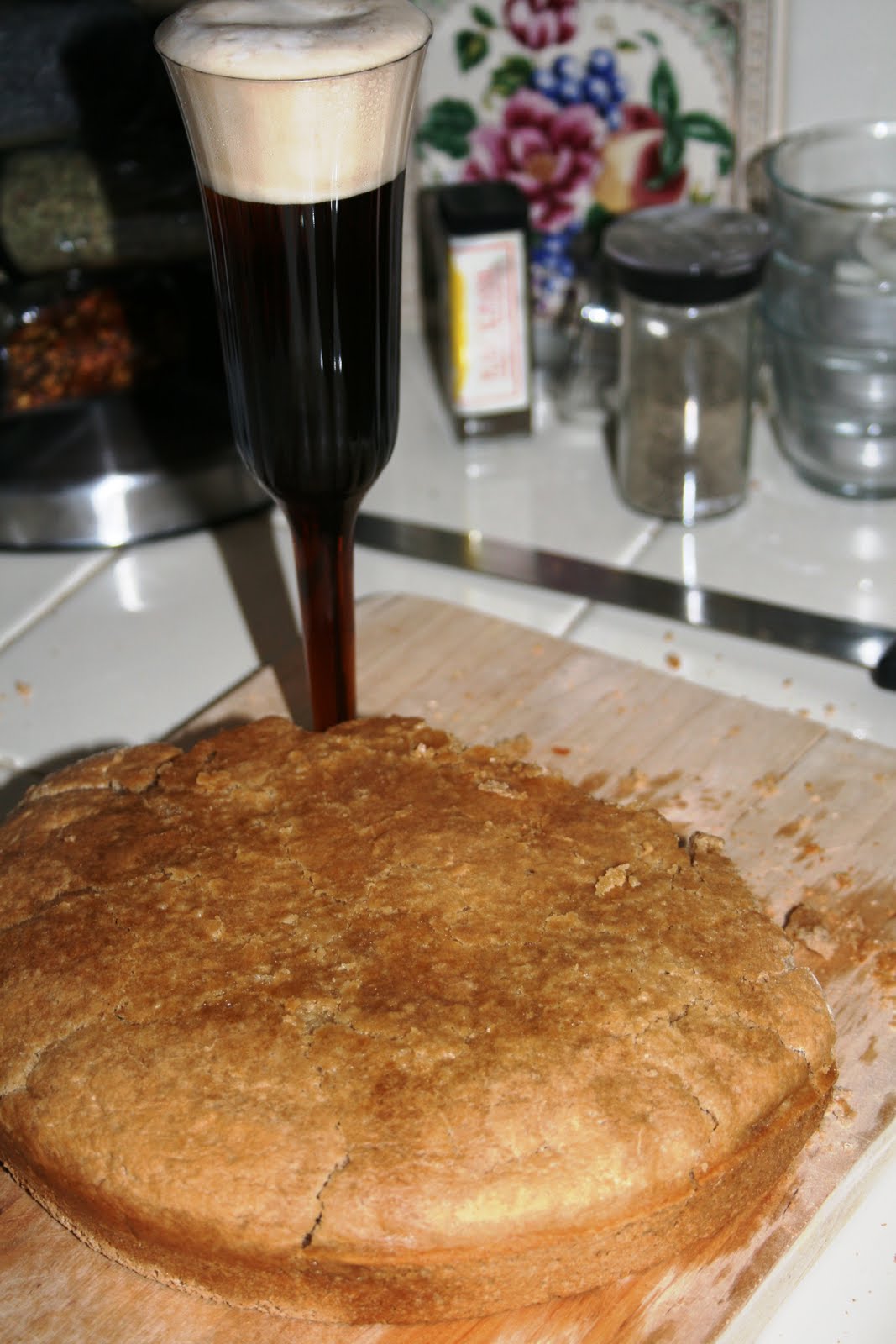
My boyfriend and I decided to try our luck at baking and make ourselves some Beer Bread. In the good hands of a recipe shared by online drinking buddy, Greg, we had a super simple recipe that needed only three ingredients, including the beer! Three ingredients?! I think even I can handle that...


Beer Bread is ready to go in the oven, with another beer poured, rewarding me for all my baking efforts! ;)

Fresh out of the oven Beer Bread.


4. Black Velvet
So I think we're all pretty familiar with the Guinness layered with another beer (Bass, et. al), but I had never thought to combine Guinness and some bubbly! Serious Eats recently had resurrected Paul Clarke's post on the Black Velvet cocktail, a cocktail that actually contains no hard liquor at all!


While Paul's recipe actually says to serve this drink in a Collins glass, there was still something oh so appealing about pouring Guinness into a champagne glass.

I hope these suggestions for using Guinness have come in handy for that 6-pack sitting in your fridge. If you have more suggestions, please feel free to share your comments.

Cheers!
SJ